

Microfibre vs Cotton: Which Cleaning Cloth Actually Cleans Better?
Every Indian home has that one drawer: a tangle of old banians, a faded kitchen towel, half a dozen mismatched cloths, and one good microfibre square that everybody fights over. If you have ever wondered why one cloth leaves your mirror sparkling and another smears it into a milky mess, the answer is in the fibre.
This guide breaks down the real difference between microfibre and cotton, when each one wins, and how to make either last for years.
What microfibre actually is
Microfibre is not simply “soft polyester”. It is a blend of polyester and polyamide split into filaments finer than a human hair — often less than one denier. Splitting the fibre does two things. First, it multiplies surface area enormously, so a single cloth has millions of tiny edges that scrape dust and grease off a surface instead of pushing it around. Second, the wedge-shaped gaps between filaments create capillary action, pulling liquid into the cloth and holding it there.
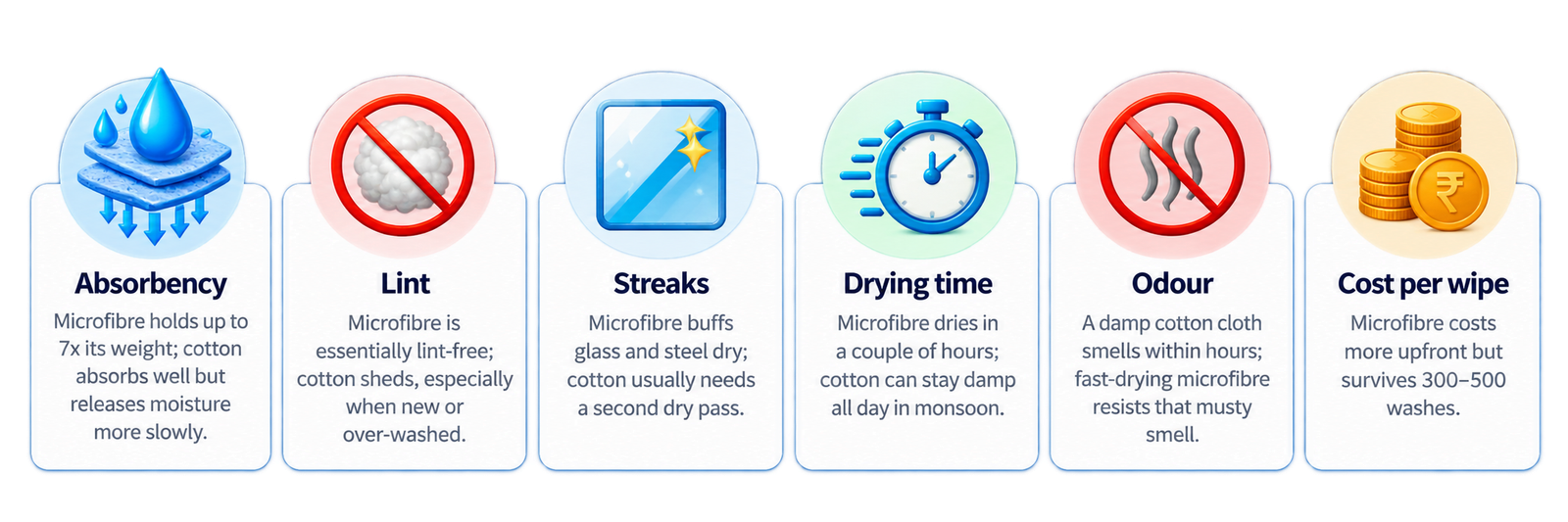
That is why a good microfibre cloth can hold several times its own weight in water and still feel merely damp, and why it lifts fine dust without needing a spray of chemicals.
What cotton does well
Cotton is a natural cellulose fibre with a hollow core. It absorbs generously, it is breathable, it tolerates very high temperatures, and it is comfortable against skin. Cotton is also forgiving: you can boil it, bleach it, dry it in harsh sun, and it will survive.
Its weakness is structural. Cotton fibres are relatively thick and they shed. That shedding is what leaves the tiny white specks on your glass table and on the car windscreen. Cotton also tends to smear rather than lift, because it has no fine edges to grab particles — it pushes them, dissolves them in water, and spreads the film.
The five-surface test
We ran the same five surfaces with both cloth types, using only water.
- Bathroom mirror. Microfibre: clear in one pass. Cotton: hazy film, needed a second dry cloth.
- Stainless steel kitchen chimney. Microfibre lifted the thin oil layer. Cotton smeared it into rainbow streaks.
- Wooden dining table with dry dal spill. Both worked. Cotton was slightly better once the spill was rehydrated, because it holds more water at once.
- Granite platform with turmeric stain. Neither cloth alone removed pigment — this is a job for a cleaner, not a cloth.
- Laptop screen. Microfibre only. Cotton is too coarse and can leave micro-scratches on coated displays.
Rule of thumb: if the surface reflects light, use microfibre. If the surface soaks liquid, cotton is fine.
Colour-coding: the habit that prevents cross-contamination
Professional housekeeping teams never use one cloth everywhere, and neither should you. Assign a colour to a zone and stick to it.
- Kitchen platform and dining — one colour, washed hottest.
- Bathroom and washbasin — a separate colour, never enters the kitchen.
- Glass, mirrors and electronics — a dedicated dry-buff cloth.
- Floors, shoes, outdoor and car — the roughest set, washed separately.
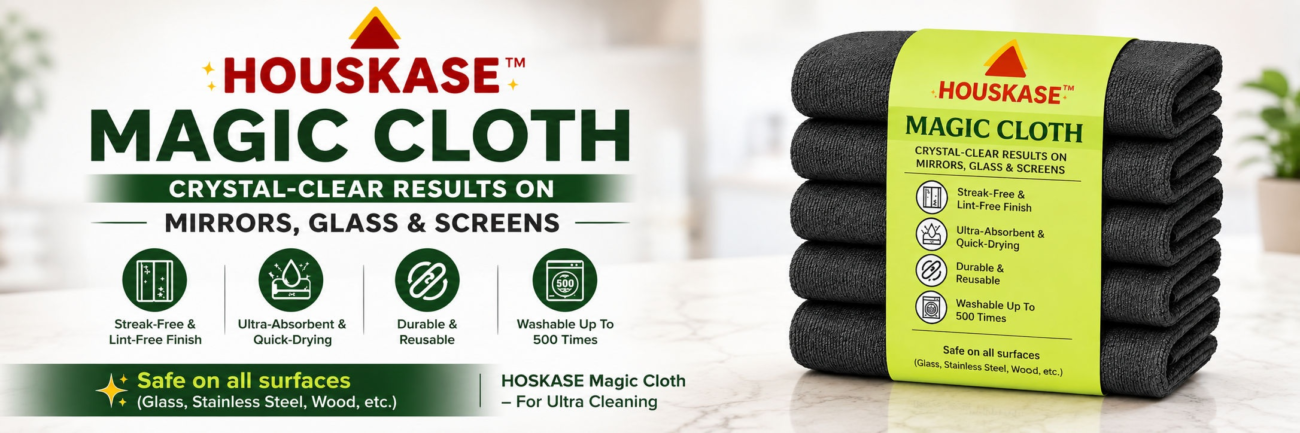
A pack of five cloths in different shades makes this effortless, which is exactly why multi-packs exist.
How to wash microfibre without ruining it
Most people kill microfibre with kindness. The two biggest mistakes are fabric softener and high heat.
- Skip fabric softener. It coats the split filaments with a waxy film and destroys the capillary action. Your cloth stops absorbing and starts pushing water around.
- Wash warm, not boiling. Around 40–60°C is ideal. Very high heat can melt the fine polyester filaments.
- Do not wash with cotton or towels. Microfibre is a magnet for lint; wash it with other microfibre only.
- Air dry or tumble on low. A hot dryer flattens the fibre structure.
- Rinse heavy grease first. Once oil saturates the fibre, a normal wash cycle will not fully clear it.
Cotton is the opposite: hot wash, strong detergent, sun-dry. The sun is a free disinfectant and it keeps cotton bright.
Cost per wipe: the number nobody calculates
A cheap cotton rag looks free because it was once a t-shirt. But you replace it every few weeks, it needs a second dry pass, and it demands more cleaning spray.
A quality microfibre cloth costs more on day one and then survives 300 to 500 wash cycles. Spread that over two years of daily use and the cost per wipe drops below a rupee — while cutting your cleaning-spray consumption, because water alone does most of the work.
Best for glass and steel
Microfibre, single pass, no spray needed.
Best for big spills
Cotton or a non-woven roll that you can throw away.
Best for electronics
Dry microfibre only, never cotton.
Best for bathroom grime
Microfibre with a mild cleaner, colour-coded and washed separately.
Best for one-time greasy jobs
A disposable non-woven cleaning cloth roll.
The realistic answer: keep both
You do not need to pick a side. A well-stocked home has three tiers:
- A five-pack of microfibre for daily surfaces, glass, appliances and dusting.
- A non-woven cleaning cloth roll for the greasy, one-time, throw-it-away jobs — chimney filters, oil spills, pet accidents.
- A few cotton cloths for hot-water mopping and jobs where the cloth needs to be boiled.
That combination handles roughly 95 percent of household cleaning, uses far less chemical spray, and stops the drawer from turning back into a tangle of old banians.
Quick checklist before you buy
- Look for GSM between 250 and 350 for general purpose microfibre; anything below 200 feels thin and wears out quickly.
- Prefer an 80/20 polyester–polyamide blend; the polyamide is what gives the cloth its grip.
- Check the edge stitching. Cheap overlocked edges fray in weeks and scratch glass.
- Buy a multi-pack in multiple colours so colour-coding actually happens.
Get those four right and your cleaning routine gets faster, cheaper and noticeably more hygienic — with one drawer, not five.